

Challenge
Design and conduct a controlled experiment to determine how sponsor type, sponsor-story alignment, and story tone influence perceived credibility of online news, with implications for digital revenue strategies and audience trust.
Overview
News, like any consumer product, is branded, packaged, and consumed by audiences who assess its trustworthiness and value. In digital journalism, credibility often turns on subtle signals, such as who sponsors a news story and how the story is framed. This study explored how sponsorships and story tone shape the way readers evaluate online news. As news organizations seek to diversify their revenue sources, sponsorships have become an attractive option. Dr. Shelly Rodgers of the University of Missouri and I designed a controlled experiment to ask a deceptively simple question: What do readers trust more—a health story “brought to you by Marlboro,” or one sponsored by the American Lung Association?
The answer was clear: Nonprofit sponsors enhanced credibility while commercial sponsors often triggered skepticism. Another striking finding was that negative news stories, such as warnings about the dangers of secondhand smoke, were seen as more credible than positive stories, like those emphasizing the health benefits of vitamin D from sun exposure. Surprisingly, whether the sponsor’s message aligned with the story (e.g., the American Cancer Society sponsoring a story about the dangers of sun tanning) or conflicted with it (e.g., Marlboro sponsoring a story about secondhand smoke dangers) had little impact on credibility.
My Role
Lead researcher: I carried out this research in my Ph.D. program at the University of Missouri. The idea for the study originated with Dr. Rodgers as part of her research on sponsorship and advertising. I designed the experimental materials, including the mock newspaper stories and survey questions, and recruited participants. I also performed the data analysis.
Methodology
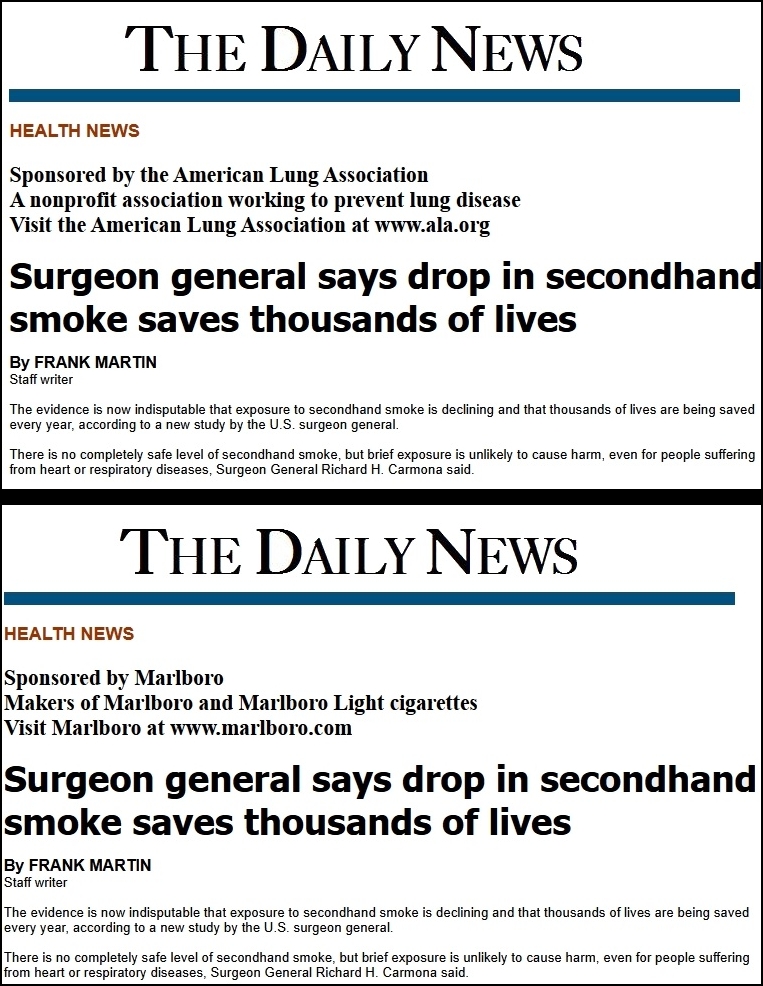
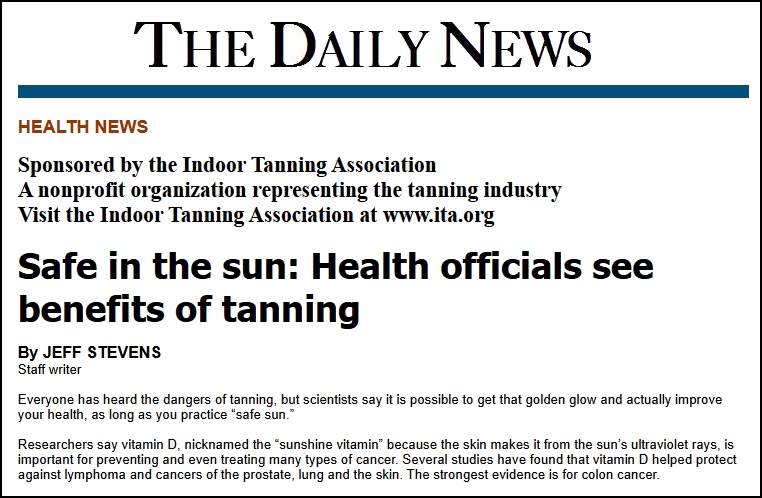
Experimental design: We conducted a 2 (sponsor type) × 2 (sponsor fit) × 2 (news story tone) experiment with 8 conditions, using a custom-designed mock online newspaper interface embedded within an online survey. Each of the 176 participants read two health-related news stories, then rated the credibility of the stories and the overall site, along with their attitudes toward the online newspaper and their likelihood of returning.
We manipulated three factors:
- Sponsor type: commercial brand vs. nonprofit organization
- Sponsor fit: whether the sponsor’s message matched or conflicted with the story’s message
- Story tone: positive vs. negative framing (e.g., highlighting lives saved by reduced secondhand smoke exposure vs. lives lost due to exposure).
Tools
SPSS FreeOnlineSurveys.comInsights and Impact
Key findings: Statistical analyses revealed that sponsor type and story tone produced significant effects. Negative stories were judged more credible than positive stories, and nonprofit sponsors outperformed commercial sponsors across the credibility measures. However, sponsor fit did not significantly impact credibility. Participants might not have been bothered by a lack of fit between the sponsor and story messages, viewing the incongruity as a sign of journalistic balance rather than a flaw.
Implications: This research highlights how brand identity and framing shape trust — a principle as relevant to digital products and UX strategy as it is to journalism. Commercial sponsorships, even subtle ones, risk undermining credibility, while nonprofit sponsors are perceived as aligned with the public interest. The preference for negative framing underscores a psychological reality: Users find cautionary information more trustworthy than overly positive messaging, which can feel “too good to be true.” For news organizations, these findings highlight the need for sponsorship policies that clearly define the boundary between news and advertising.
Significance: This project showcased my ability to design sophisticated multi-variable experiments, translate psychological theory into testable conditions, and uncover actionable insights. These insights apply not only to journalism but also to brand strategy, content design, and any environment where user trust is critical.
Deliverable
This research was presented at an Association for Education in Journalism and Mass Communication (AEJMC) conference in Chicago, Illinois.
 Kyle Heim