

Challenge
Lead a comprehensive mixed-methods research project to determine whether political blogs influenced journalists and candidates during the early 2008 U.S. presidential campaign or simply echoed mainstream media coverage.
Overview
Campaign websites first appeared during the 1996 presidential campaign, but 2008 marked a turning point with the rise of interactive platforms such as blogs featuring user-generated content. The blogosphere was buzzing with political commentary about the Obama-McCain race, but did all of the discussion actually make a difference or was it mostly just noise?

In my doctoral dissertation at the University of Missouri, I examined whether the emerging blogosphere helped set the agenda during the early weeks of the 2008 campaign. I explored whether the issues and frames emphasized in the most prominent political blogs influenced journalists and the candidates: Were bloggers driving the campaign narrative or merely piggybacking on media coverage of the race?
My Role
Principal investigator: This was a solo, end-to-end research project completed under the supervision of my dissertation adviser. I was responsible for the study design, data collection, analysis, and final reporting over the course of more than a year. A fellow doctoral student assisted in the content analysis coding process to ensure reliability.
Methodology
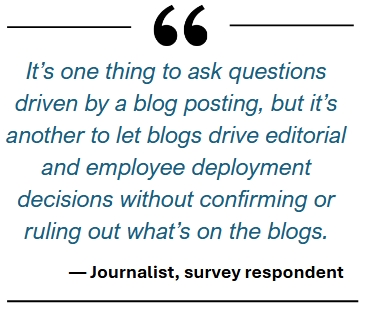
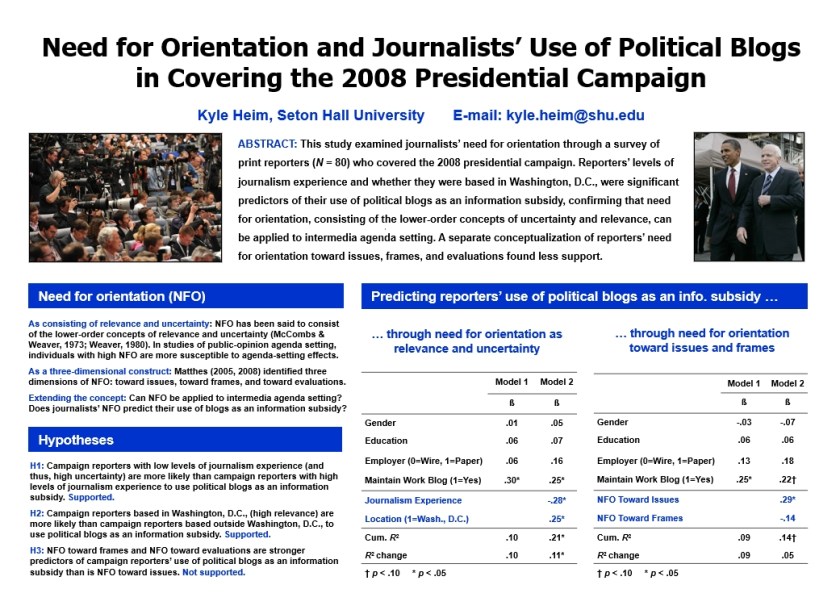
Survey: I conducted an online survey of newspaper and wire-service reporters who covered the 2008 election. Reporters were identified through news databases and invited via email to participate. A total of 80 reporters completed the 26-question survey on their use of political blogs.
Quantitative content analysis: I analyzed 880 posts from prominent liberal, conservative, and neutral political blogs, 280 campaign-related news articles, and 257 candidate press releases from the four weeks prior to the 2008 Iowa Democratic caucuses. This early campaign window is when opinions about the race are being formed and the potential for agenda-setting influence is greatest. I focused on the Democratic contest because it was highly competitive and had greater visibility than the Republican race. Content was categorized for issues (e.g., health care, the economy) and candidate attributes or frames (e.g., experience, electability).
Tools
SPSS FreeOnlineSurveys.com News databases (LexisNexis, Factiva, NewsBank)Insights and Impact
Survey results: Journalists covering the 2008 campaign frequently read political blogs; more than half reported reading them daily. Liberal and politically neutral blogs were widely read, but conservative blogs were barely read at all. Reporters who regularly covered the campaign and those who contributed to a blog themselves reported the highest levels of blog exposure.
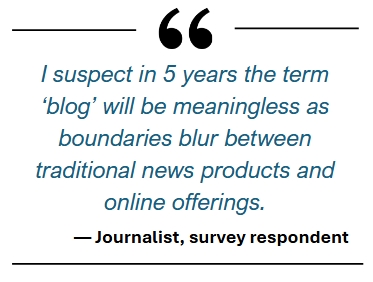
Content analysis results: While political blogs and the news media covered similar issues and used similar framing (with high agenda correlation), blogs mostly followed the news media’s lead (as determined via cross-lagged correlations and time-series analysis). However, liberal blogs showed modest influence on news coverage early in the study period. No evidence of bloggers’ influence on candidate messaging was found.
Implications: Political blogs may have mobilized partisan activists and captured the attention of the news media in 2008, but their impact on journalists’ work was quite limited. To the extent that blogging introduced new voices into the national political debate, those voices were mostly speaking the same language as the elite news media. Claims of blogging’s democratic potential might be overstated.
Significance: This early study of blogs’ influence on political communication has informed later work on how online platforms are disrupting the political and media landscape. My Journalism & Mass Communication Quarterly article based on the project (see “Deliverables” below) has been cited more than 70 times.
Deliverables
Dissertation: The 247-page dissertation was successfully defended before my committee in 2010.
Publications: This project resulted in two peer-reviewed journal articles:
- “Framing the 2008 Iowa Democratic Caucuses: Political Blogs and Second-Level Intermedia Agenda Setting,” Journalism & Mass Communication Quarterly, 2013.
- “Need for Orientation Predicts Reporters’ Reliance on Blogs,” Newspaper Research Journal, 2015. This research also was presented at the 2010 Association for Education in Journalism and Mass Communication (AEJMC) conference in Denver, Colorado.
 Kyle Heim