
I teach 10 undergraduate and graduate courses at Shippensburg University in media literacy, multiplatform media writing and editing, social media analytics and strategy, applied research, publication design, and media law and ethics. My teaching draws on my background as a researcher and a journalist, emphasizing hands-on, interactive activities that prepare students for today’s fast-changing, digital-first media environment. I also regularly advise strategic communication graduate students’ capstone client-based professional projects.
Below are descriptions of the courses I teach and their syllabi. Click on a link to go directly to the description and syllabus for that course.
- COMM 520: Strategic Communication Research (online graduate course)
- COMM 525: Social Media Analytics and Strategy (online graduate course)
- COMM 111: Media Literacy
- COMM 112: Media Writing
- COMM 285: Basic News Reporting
- COMM 293: News Editing and Design
- COMM 294: Social Media Strategy
- COMM 345: Media Law
- COMM 375: Advanced News Reporting
- COMM 381: Promotional Publication Design
✅ COMM 520: Strategic Communication Research (online graduate course)
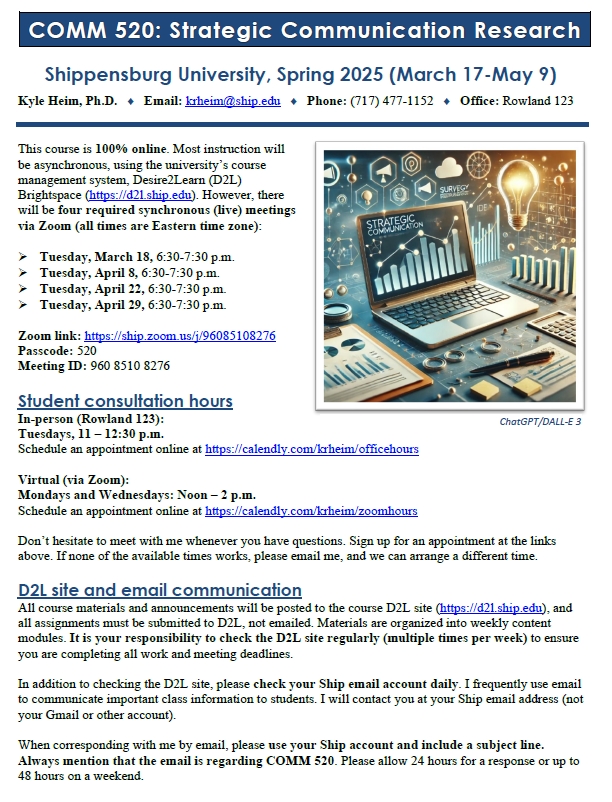
Introduces graduate students to several common research methods and their application to the strategic communication field. Students learn how to conduct surveys, focus group interviews, and content analysis to examine media messages and audiences. Sampling techniques, reliability and validity, and research ethics also are addressed. Students learn strategies for analyzing and interpreting data to find solutions to practical communication problems.
- Key assignments/activities: I guide graduate students through the research life cycle, from selecting a topic, conducting a literature review, and posing research questions to designing and carrying out quantitative and qualitative research and analyzing data. Students design online surveys in Qualtrics and create focus group protocols. They also become CITI-certified by completing training in research ethics.
✅ COMM 525: Social Media Analytics and Strategy (online graduate course)
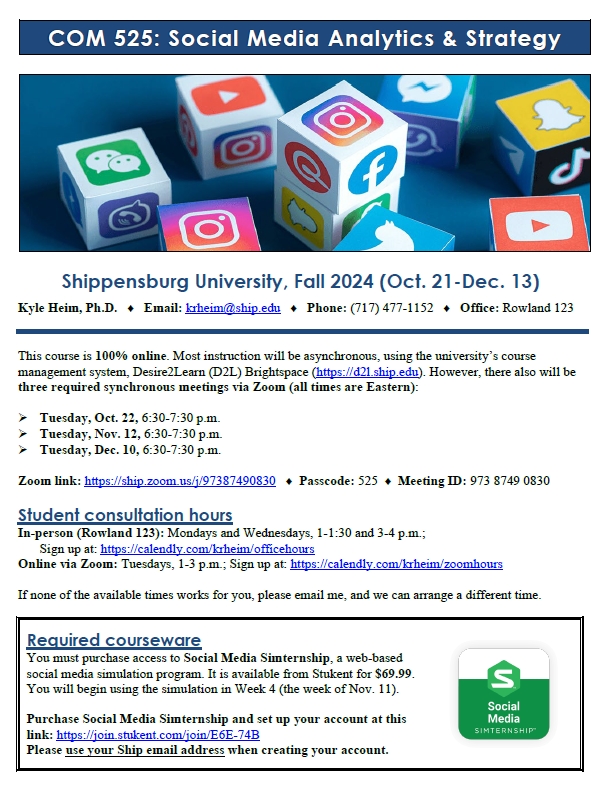
Teaches graduate students how to leverage social media for strategic communication purposes. They gain hands-on experience creating social media content and using various methods and tools for collecting, interpreting, and presenting analytical data from social media platforms. They use insights gained from the data to formulate social media strategies and provide actionable recommendations.
- Key assignments/activities: Students earn HubSpot Social Media Marketing certification and use basic social media analytics tools and dashboards. They complete Stukent’s Social Media Simternship, a competitive web-based simulation in which they create organic, paid, and influencer content for Buhi Supply Co., a fictitious retailer specializing in backpacks and duffel bags. At the conclusion of the simulation, each student delivers a video presentation to Buhi’s board of directors evaluating the success of their social media efforts and sharing strategic insights and recommendations.
✅ COMM 111: Media Literacy
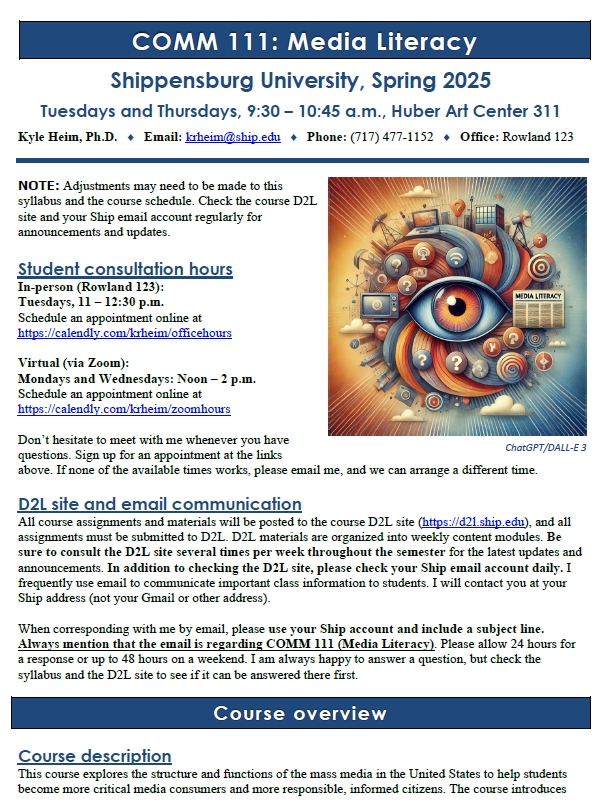
An introductory core course for all undergraduate Communication, Journalism and Media majors and minors and a university general-education course in citizenship and responsibility. Explores the structure and functions of the mass media in the United States to help students become more critical media consumers and more responsible, informed citizens. Introduces students to the history and operation of various media industries, as well as the mass media’s roles, ethical responsibilities, and First Amendment protections in a democratic society.
- Key assignments/activities: Students create a poster that explores the role of diverse cultures and professionals in the development of the mass media, highlighting three historical figures who made significant contributions. They also complete a team project analyzing a contemporary example of misinformation or disinformation in the media, explaining its origin and impact, as well as the role of social media and AI in both spreading and the debunking the false information.
✅ COMM 112: Media Writing

An introductory core course for all undergraduate Communication, Journalism, and Media majors and minors. Teaches students the building blocks of effective writing. Focuses on the mechanics of grammar, punctuation, and spelling and introduces writing styles and techniques used in print and online media, radio, television, and public relations.
- Key assignments/activities: During the first half of the semester, students receive instruction and tutoring in writing mechanics. They must pass a proficiency exam to continue in the Communication, Journalism, and Media major or minor. During the second half of the term, students complete writing assignments tailored to different media industries and formats.
✅ COMM 285: Basic News Reporting (formerly News Writing and Reporting)
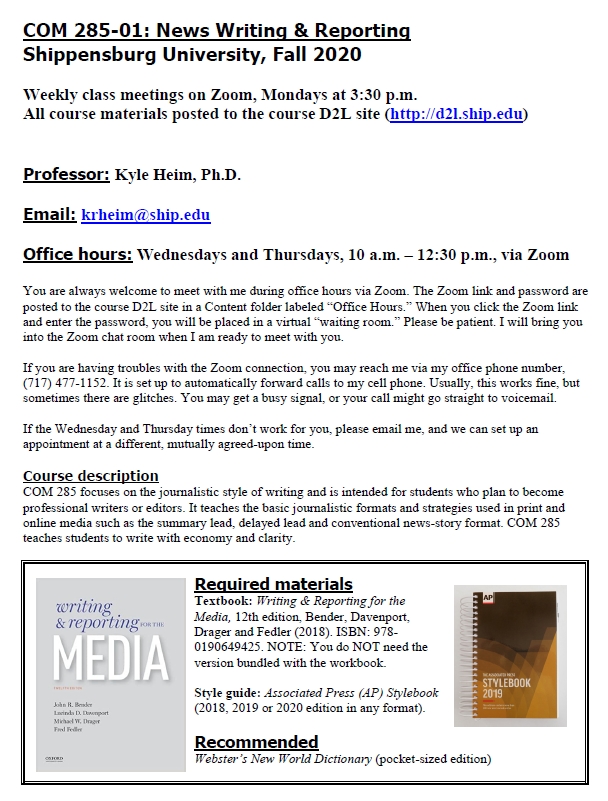
Familiarizes students with the journalistic style of writing to prepare them for careers as reporters, editors, or content creators. Provides instruction in the basic formats and strategies used in print and digital media, including traditional and alternative news lead and story structures. Students learn to write with economy and clarity, exercise sound editorial judgment, and consider the needs of their audience.
- Key assignments/activities: Students complete weekly writing assignments, including inverted-pyramid, hourglass, and focus structure news stories, as well as personality profiles, speech and meeting stories, and live-tweeting.
✅ COMM 293: News Editing and Design
Teaches students the basics of audience-centric editing for print and digital media, including micro editing to fix spelling, grammatical, and style errors; macro editing to improve clarity and flow; and editing for taste and fairness. Students learn to write compelling, SEO-friendly headlines, photo captions, and other display type. They also learn the fundamental principles of news design and how to use Adobe InDesign software to create newspaper layouts.
- Key assignments/activities: Students complete a variety of editing assignments and drills. In one assignment, students compare their editing of a news story with the edits suggested by generative AI. For the final project, each student designs a multipage newspaper spread using InDesign and is responsible for selecting and editing the stories and photos and writing all headlines, captions and other display type.
✅ COMM 294: Social Media Strategy
Introduces students to a variety of social media tools and platforms and their use by communication professionals for information gathering, publicity, promotion and audience engagement. Broadens students’ understanding of social media principles while providing practical, hands-on experience in social media planning, content creation and analytics.
- Key assignments/activities: Students obtain Hootsuite Platform Certification and use Keyhole for basic analytics. Hands-on assignments include creating buyer personas to represent a social media target audience, assisting a hypothetical client in strategizing a social media campaign, producing engaging posts and videos about an assigned event, and interviewing a communication professional about their use of social media in the workplace.
✅ COMM 345: Media Law

Familiarizes students with the laws and regulations governing the U.S. mass media. Deals with fundamental legal topics, including libel, privacy, obscenity, copyright, and the regulation of broadcasting and advertising. Students explore seminal Supreme Court and lower court rulings that have influenced the application of the First Amendment and the rights and operations of the mass media and society at large.
- Key assignments/activities: The main course project involves researching and comparing the legal protections for freedom of expression in the United States with those of several other countries in regard to freedom of the press, freedom of speech, and the rights to assemble and petition.
✅ COMM 375: Advanced News Reporting

Focuses on the beat system of news reporting as a means to gather and disseminate information for multiple platforms. Students learn about the gathering and reporting of news of government and politics; law enforcement agencies and the courts; educational institutions; labor, business and financial institutions; science and health; and other institutions of public interest.
- Key assignments/activities: Students complete numerous writing and reporting assignments, including covering a City Council meeting and a court proceeding, as well as current-events quizzes. Each student chooses a news beat and is responsible for monitoring the beat, producing an event story, issue story, and personality profile.
✅ COMM 381: Promotional Publication Design
Equips students with the design skills and conceptual knowledge needed to develop effective promotional content and design strategies. Examines practical applications of basic contemporary design to public relations materials such as newsletters, flyers, posters, brochures, and business cards. Students gain extensive hands-on experience using Adobe InDesign software.
- Key assignments/activities: The course is structured around the four “CRAP” design principles in Robin Williams’ Non-Designer’s Design Book: contrast, repetition, alignment and proximity. Students apply these principles by producing a variety of promotional materials in InDesign. For the final project, they design newsletters and trifold brochures for a fictional client.
 Kyle Heim